


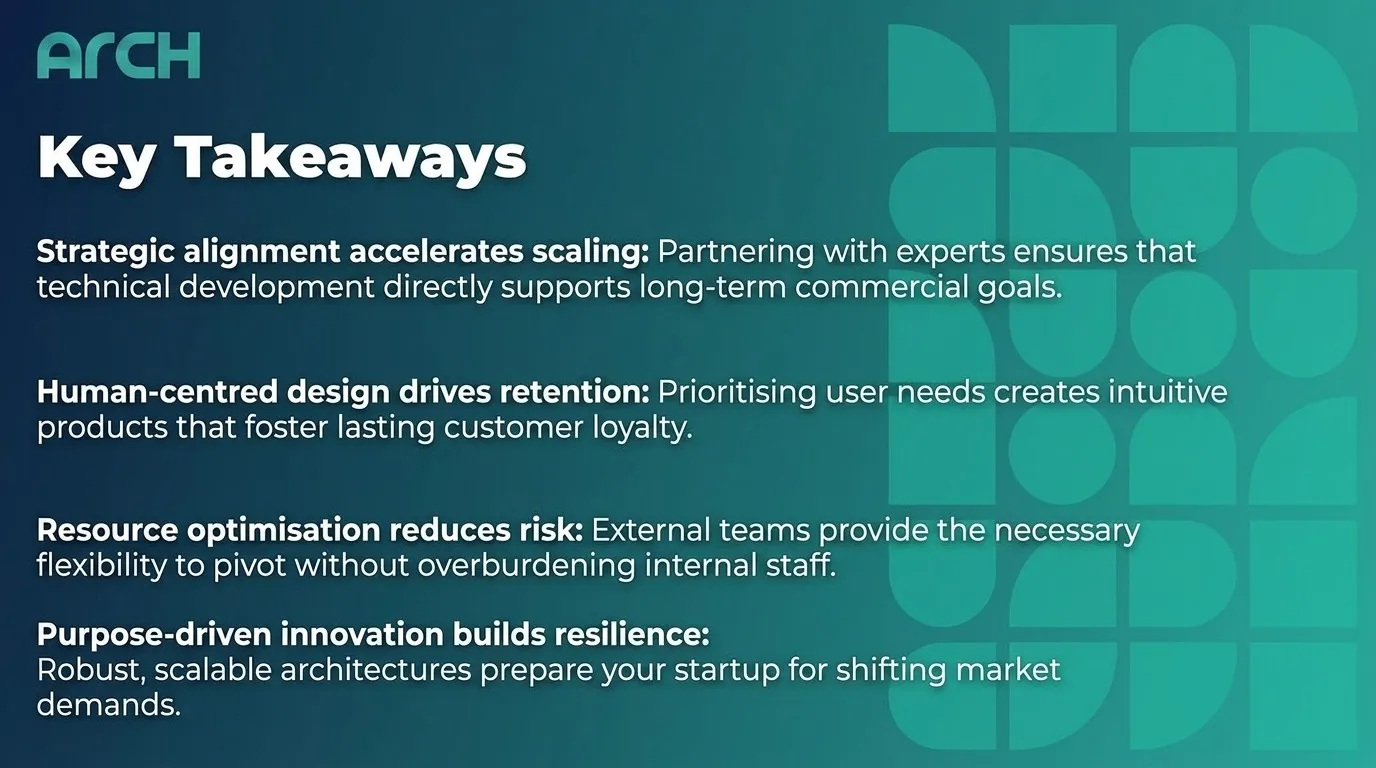
Key Takeaways
- Strategic alignment accelerates scaling: Partnering with experts ensures that technical development directly supports long-term commercial goals.
- Human-centred design drives retention: Prioritising user needs creates intuitive products that foster lasting customer loyalty.
- Resource optimisation reduces risk: External teams provide the necessary flexibility to pivot without overburdening internal staff.
- Purpose-driven innovation builds resilience: Robust, scalable architectures prepare your startup for shifting market demands.
The Innovation Imperative
In today’s fast-paced commercial environment, simply possessing a strong idea is rarely enough to guarantee long-term success. Startups face immense pressure to not only bring concepts to market quickly but to build robust frameworks that can withstand shifting consumer behaviours. Achieving this requires a delicate balance of agility, technical prowess, and strategic foresight.
Many ambitious founders attempt to navigate these complexities by stretching their internal teams or relying on fragmented agency networks. However, this often leads to disjointed user experiences and misaligned commercial objectives. To truly build a resilient foundation, leadership teams must look beyond short-term fixes and seek out expert partners capable of delivering holistic, impact-driven solutions.
This is where a strategic alliance becomes a true catalyst for sustainable expansion. By integrating external expertise into your core operations, you can optimise your growth trajectory while maintaining a steadfast focus on your unique market proposition.
Moving Beyond Traditional Outsourcing
The traditional model of outsourcing technical tasks is increasingly viewed as outdated for startups aiming to make a significant market impact. Treating development as an isolated commodity often results in digital products that function mechanically but lack soul and purpose. Founders need more than just code; they need collaborative insight that lends colour and nuance to the core offering.
Partnering with a web design and software development company represents a profound shift in this dynamic. Unlike standard agencies that execute prescriptive briefs, these studios embed themselves within your organisation to understand your vision, challenges, and target audience. They act as expert partners, bringing a wealth of cross-industry experience to refine and elevate your original concept.
This collaborative approach ensures that every feature developed is rigorously tested against real-world demands. By breaking down the silos between design, engineering, and business strategy, you can confidently build products that are both technically exceptional and deeply resonant with your end users.
Engineering Human-Centred Solutions
At the centre of any successful startup is a product that genuinely solves a problem for its users. Empathy must be woven into the digital architecture from the very first wireframe. Human-centred innovation is not merely an industry buzzword; it is a rigorous methodology that places user behaviour at the forefront of the design process.
When you prioritise the user experience, you are actively future-proofing your business. Digital products that intuitively align with how people think and act naturally command higher engagement rates and lower customer acquisition costs. Expert teams utilise comprehensive user research to craft interfaces that are accessible, engaging, and culturally relevant.
Furthermore, this dedication to user-centricity allows startups to iterate with purpose. Instead of relying on guesswork, leadership can make informed decisions based on empirical feedback. This reduces the friction typically associated with scaling and ensures your product evolves in tandem with your audience’s changing needs.
Scaling with Purpose and Precision
Optimising growth requires a technical foundation capable of expanding without collapsing under its own weight. Attempting to scale a fragile infrastructure is one of the most common pitfalls for rapid-growth startups, often leading to costly rebuilds and prolonged system downtimes. Developing a resilient architecture early on is essential to help founders realise their long-term vision.
Mitigating Technical Debt
A dedicated studio partner understands how to balance speed-to-market with the necessity of a rigorous development programme. They implement robust development frameworks that accommodate future integrations, ensuring your digital ecosystem remains flexible and free from crippling technical debt. This ambitious yet accessible approach to engineering means you can seize new market opportunities without hesitation.
Ultimately, rapid growth should never compromise the quality of the user experience or the integrity of your core mission. By aligning your technical strategy with your commercial ambitions, you create a sustainable momentum that propels your startup forward, leaving competitors struggling to adapt to the pace of your innovation.
Conclusion
Future-proofing a startup is an ongoing commitment to adaptability, user-centricity, and strategic collaboration. The journey from a nascent idea to a market-leading enterprise is fraught with technical and commercial hurdles. Attempting to clear these obstacles in isolation is a risk that modern founders simply do not need to take.
By forging an alliance with expert partners who share your drive for impact, you can transform your digital offering into a dynamic engine for growth. The right collaboration empowers your internal team, optimises your operational resources, and ensures your product remains relevant in a highly competitive landscape.
Embrace purpose-driven innovation as the cornerstone of your strategy. When you build with intention, scale with precision, and prioritise the human experience, you secure a resilient, prosperous future for your business.
Frequently Asked Questions
What distinguishes a product studio from a traditional development agency? A product studio operates as a collaborative partner involved in the entire lifecycle of a product, from ideation and strategy to design and engineering. Traditional agencies often focus solely on executing predefined technical briefs without contributing to the overarching business strategy.
How does human-centred design impact financial growth? Human-centred design directly improves user retention and engagement by creating intuitive and enjoyable experiences. High retention rates lower overall customer acquisition costs and increase lifetime value, thereby optimising financial performance.
When is the right time for a startup to seek external technical partnerships? Startups should consider external partnerships when they need to scale rapidly, lack specialised in-house expertise, or when technical debt begins to slow down product iteration. Engaging experts early can prevent costly architectural mistakes.
Sources
- McKinsey & Company: The Business Value of Design
- Harvard Business Review: Why Startups Fail
- Forrester: The ROI of Custom Software Development
- Nielsen Norman Group: User Experience Careers and ROI